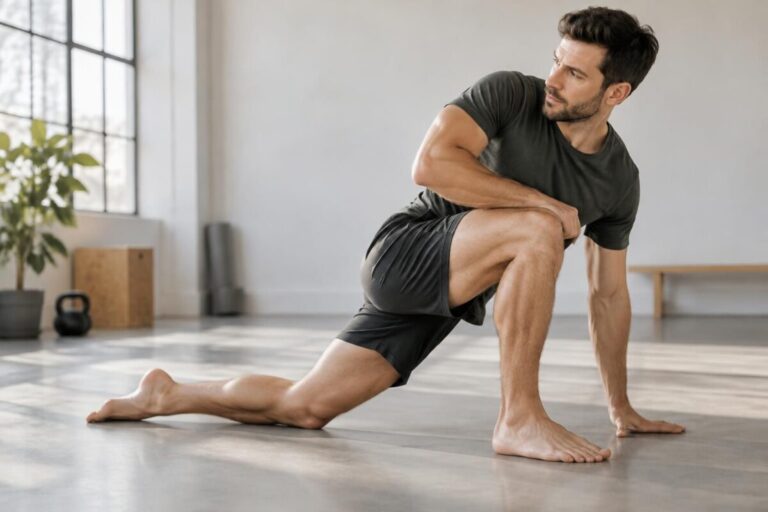
Mobility: Can stretching too early hold you back?
Hello, this is Néora.
Yes, holding static stretches for too long just before intense exertion can temporarily reduce your strength and performance. Before your workout, focus instead on a dynamic warm-up and active mobility, and save held stretches for afterward.
The right time to stretch therefore depends on your goal: preparing your body, improving flexibility, or winding down after exercise. The key is to move with control, without seeking pain.
Try this right now:
- Start with a few minutes of brisk walking, cycling, or light movement.
- Before training, mobilize the joints you’ll be using.
- Avoid long static holds just before a strength or speed workout.
- After exercise, gently stretch tight areas without bouncing.
- To make progress, choose a short, regular routine over an intense, infrequent session.
To get ready for a workout without staying still, check out these dynamic stretches that are useful for warming up and this ten-minute mobility routine.
Why stretching too early can hinder your performance
A static stretch involves holding a muscle in an elongated position. If you hold it for a long time just before explosive exertion or a heavy set, your strength may dip slightly for a short time. The effect varies depending on the duration, the exercise, and the person: this is no reason to ban stretching, but rather to choose when to do it more wisely.
Before exercising, your body mainly needs to warm up and rehearse the movements it’s about to perform. Active movements gradually prepare your muscles and joint range of motion while developing control. “A warm-up prepares you to move; it shouldn’t put you to sleep.”
Stretching and mobility: two different tools
Passive stretches mainly develop flexibility: you hold a position and let the muscle lengthen. Mobility combines range of motion, strength, and control. It helps you actively use that range of motion in a squat, a stride, or an overhead movement.
Both can have a place in a complete fitness routine. Before exercise, prioritize dynamic mobility; afterward, gentle stretches can help release tension and help you wind down. They won’t make soreness disappear on their own, and they don’t replace an appropriate progression.
The right time to stretch, depending on your workout
| When | What to prioritize | What to avoid |
|---|---|---|
| Before training | Dynamic movements and targeted mobility for about 5 to 10 minutes, depending on the workout. | Long static holds just before intense exertion. |
| Between sets | Rest and light movements if you need them. | Holding a long stretch for the muscle you’re working between heavy sets. |
| After training | Cool down, then do gentle stretches for 20 to 45 seconds, as feels comfortable. | Forcing a stretch or trying to make pain disappear. |
| On a day without intense training | A mobility routine or gradual flexibility work. | Relying on one long session to make up for everything. |
Two simple scenarios to help you choose
If you’re going to do heavy squats or sprints, warm up with bodyweight squats, lunges, and dynamic movements. If you want to improve your flexibility on a rest day, start with a few easy movements, then hold each stretch without pain.
An easy-to-follow, three-step warm-up
- Step 1 — Warm up: Move lightly for 3 to 5 minutes. Walk, pedal, or do a few high knees at an easy pace.
- Step 2 — Mobilize the areas you need: Choose two or three movements related to your workout, such as shoulder rotations, hip circles, or knee-to-wall ankle mobilizations. Use a comfortable range of motion and controlled movement.
- Step 3 — Rehearse the movement: Repeat the planned movement with little or no weight, then gradually increase the intensity. After your workout, slow down and stretch only the areas that need it.
Anecdotes can often say more than a long speech: one beginner used to prepare for squats by staying bent over toward her feet for a long time. When she replaced this habit with light squats and ankle mobilizations, she found her warm-up flowed more smoothly.
Avoid mistakes that turn stretching into a strain
Don’t stretch intensely when your muscles are cold, and don’t bounce to increase your range of motion. Mild tension is generally acceptable; sharp pain, numbness, or joint discomfort means you should stop the movement.
Injury prevention relies on several habits: an appropriate warm-up, gradual strengthening, sufficient recovery, and movements you can control. Flexibility alone doesn’t guarantee better protection. What matters is building a useful range of motion and mastering it.
A short routine to maintain your mobility
- Hips: controlled circles, then a low lunge without forcing it.
- Ankles: gently move your knee toward a wall while keeping your heel on the floor.
- Upper back: alternate between rounding and arching your back, then add a few rotations.
- Shoulders: make large circles or pass your arms overhead with a light stick.
A few minutes regularly is enough to build the habit of moving. Adjust the duration and exercises to suit your situation, your training, and how you feel: quality of movement comes before quantity.
Frequently asked questions about stretching and mobility
Should you stretch before exercising?
Before an intense workout, prioritize a dynamic warm-up and mobility exercises. Prolonged static stretches may temporarily reduce strength or explosiveness in some people.
How long should you hold a stretch after training?
A 20- to 45-second hold may be appropriate, depending on the area and how you feel. Breathe calmly and stop if you feel sharp pain.
Does mobility replace stretching?
No. Mobility works on active movement and its control; passive stretches mainly target flexibility. These practices complement each other and are done at different times.
Does stretching prevent muscle soreness?
Stretching alone doesn’t prevent it. Appropriate recovery also depends on training load, rest, and a gradual return to exercise.
P.S. Leave me a comment; I’ll reply personally.
Thank you for your interest… Best wishes; Néora