Mobility: hip mobility, how long does it take to make gains?
Hi everyone, Néora here. There is no guaranteed timeline for improving hip mobility: feeling more flexible after one session is not the same as making lasting progress. Monitor your comfort, range of motion, and movement control over several weeks, using exercises suited to your situation. Hip mobility is essential not only for sports but also for everyday comfort, especially if you spend a lot of time sitting or feel stiff when you wake up.
Do this right away:
- Start with a simple, comfortable movement without trying to reach your maximum range of motion.
- Practice hip circles on all fours to gently work on your mobility.
- Strengthen your muscles with glute bridges to improve stability and flexibility.
- If a lunge feels comfortable, stay within a comfortable range of motion and use support if needed.
- Choose short sessions you can repeat, with a gentle warm-up and suitable progression.
In the meantime, check out the key exercises to loosen up your hips and learn how mobility affects your squats. These resources will help you better understand your mobility and work on it effectively.
Why improve hip mobility?
Hip mobility refers to the joint’s ability to move freely through a wide range of motion. It’s essential for walking, running, or simply sitting without pain. Restricted mobility can make certain movements difficult, but back or knee pain is not automatically caused by the hips. Mobility combines the available range of motion with the ability to control it; aiming for ever-increasing flexibility is not a universal goal.
Prolonged periods of sitting are often associated with stiffness and even reduced flexibility. Moving regularly may help, but results depend on the cause of the discomfort, your activity level, and the program you choose.
Which exercises should you prioritize for hip flexibility?
To improve your mobility effectively, it’s important to combine stretching and strengthening.
- Pigeon stretch: a challenging option to avoid if it causes discomfort in your knee or hip; it isn’t essential.
- Hip rotations: slowly rotate your knees while on all fours to improve joint mobility.
- Glute bridge: gently strengthens the surrounding muscles.
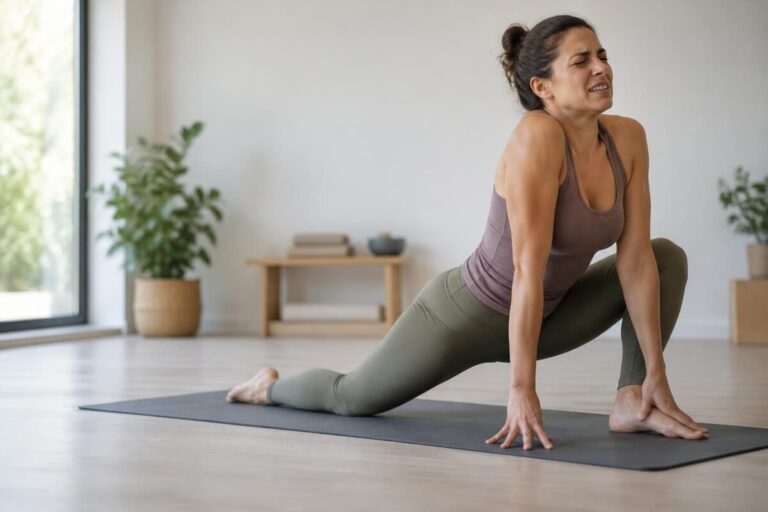
- Supported lunges: adjust the depth to maintain control of your pelvis, without pushing into pain.
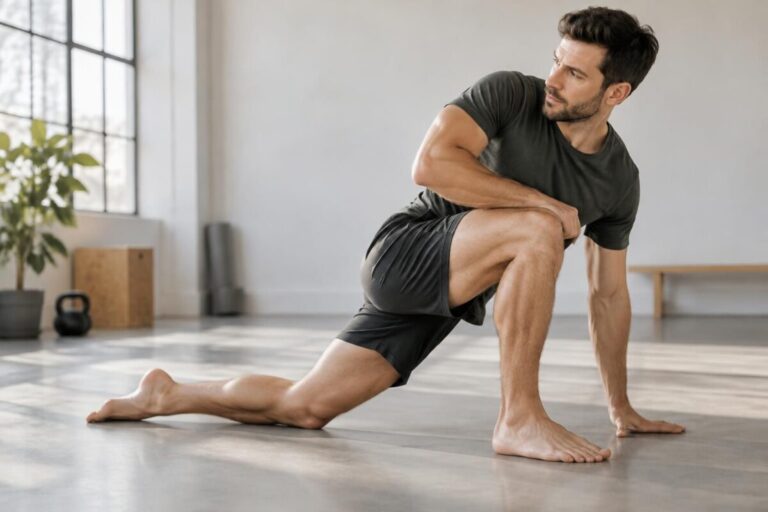
- 90/90 exercises: an option for working on rotation if the position feels comfortable; use supports to modify it.
Don’t automatically do all these movements together. The NHS recommends progressing gradually with flexibility exercises. Choose a short routine you can tolerate, then adjust the difficulty rather than forcing a position.
How long does it take to see real improvement?
| What you notice | What it may indicate | How to track it |
|---|---|---|
| Moving more easily right after a session | An immediate effect that may be temporary | Don’t mistake it for a lasting increase in range of motion |
| The same movement feels easier over the course of several weeks | Possible improvement in comfort or control | Compare under similar conditions, without forcing the movement |
| Increasing pain, pinching, or discomfort | An exercise or workload that needs to be reassessed | Stop the movement in question and seek advice if it persists |
Regular practice helps you maintain a routine, but spending more minutes does not automatically mean making more progress. A review of researchers’ recommendations on stretching distinguishes between the immediate effects and the effects of ongoing training on range of motion. It does not allow anyone to promise a personal recovery timeline or a date when pain will disappear.
A simple 3-step process to maximize your hip mobility
- Warm up with a few minutes of gentle walking or comfortable movements; there’s no need to jump.
- Do targeted exercises: choose one or two movements you can control. Reduce the range of motion or stop if it causes pain; adjust the repetitions and hold time to suit your abilities.
- Finish with an active cool-down by returning to a gentle activity and noting how you feel, without assuming that you won’t feel stiff.
There is no single “most effective” exercise for everyone’s hips. The physiotherapy advice from Cambridge University Hospitals points out that you should seek advice if a stretch is painful. If you have pain or a known limitation, a physiotherapist can select suitable variations.
If you play a sport, connect your mobility work to the movement you need and appropriate strengthening. A large range of motion without control is not necessarily more useful; no program can guarantee that you’ll avoid all injuries.
Taking care of your hips also means listening to your body
Every body responds differently, so listening to yours is essential to avoid aggravating any tension. Mobility is often a gentle process that takes time. If you have persistent pain, it’s always best to consult a professional for a suitable rehabilitation program.
How can you track your progress without testing yourself every day?
Choose a useful movement, such as putting on your shoes or getting up from a chair. Note what feels difficult and compare periodically under the same conditions. Feeling more comfortable without pain matters more than a photo taken while forcing a position. If you don’t make progress despite following an appropriate routine, have the program reassessed rather than pushing harder.
Common mistakes to avoid when improving hip mobility
- Skipping the warm-up, which increases the risk of injury.
- Pushing through pain instead of respecting your body’s limits.
- Practicing inconsistently.
- Neglecting to strengthen the muscles around your hips.
- Not varying your exercises.
How long does it really take to improve hip mobility?
The timeline varies depending on the limitation, the program, and your starting abilities. An immediate effect doesn’t prove lasting progress; observe changes over several weeks without setting a guaranteed deadline.
Can everyone improve their hip mobility?
Many people can make progress with a suitable routine, but what’s possible depends in part on the cause of the limitation. Pain or a known condition requires individualized advice.
Which exercises are most effective for loosening up the hips?
The choice depends on which movement is limited and what you can tolerate. Start with comfortable variations, without forcing the movement or treating any position as mandatory.
Can you lose mobility if you stop doing the exercises?
Yes, mobility is maintained through regular practice. A prolonged break may lead to gradually increasing stiffness.
Should you consult a professional to improve your mobility?
You should see a doctor or physiotherapist if pain persists, gets worse, or limits your activities. After an injury or surgery, follow your healthcare team’s instructions.
Thanks so much for reading… Best wishes; Néora PS: Leave me a comment and I’ll reply personally